
Upson County 72 Hour Releases
Upson County does not publish a verified page labeled 72-hour releases. The practical official method uses the Interop Inmates By Arrest Date view. Set a start and end date covering the prior three days, review the matching bookings, and identify entries marked RELEASED. This produces a useful three-day check without claiming that the county offers a purpose-built release feed.
The distinction prevents a common mistake. Selected dates refer to arrest activity, not necessarily discharge time. A person arrested before the range could have been released inside it and may not appear. Someone booked during the range may still be held. Status resolves the current presentation for each listed entry, while the sheriff's discharge record resolves the precise release date, time, reason, and authority.
Search Upson Three-Day Releases
Choose calendar dates with care. A 72-hour interval can cross parts of four dates, while the public tool uses dates rather than an hour slider. Include the full relevant arrest dates, then narrow records with identity and case fields.
- Open Upson Inmates By Arrest Date.
- Set the beginning date to cover the prior three days and the ending date to today.
- Compare the full name, descriptors, arrest date, and arresting agency for each possible match.
- Look for RELEASED. Do not confuse it with CURRENTLY BOOKED.
- Note the court, warrant, charge, and bond details needed for confirmation.
- Contact the sheriff for an exact discharge record when timing or release authority matters.
For a booking from today or yesterday, the Released Last 24 Hours view is faster. The date-range route is better for catch-up work and older bookings.
Check the live arrest-date search before using the captured example.
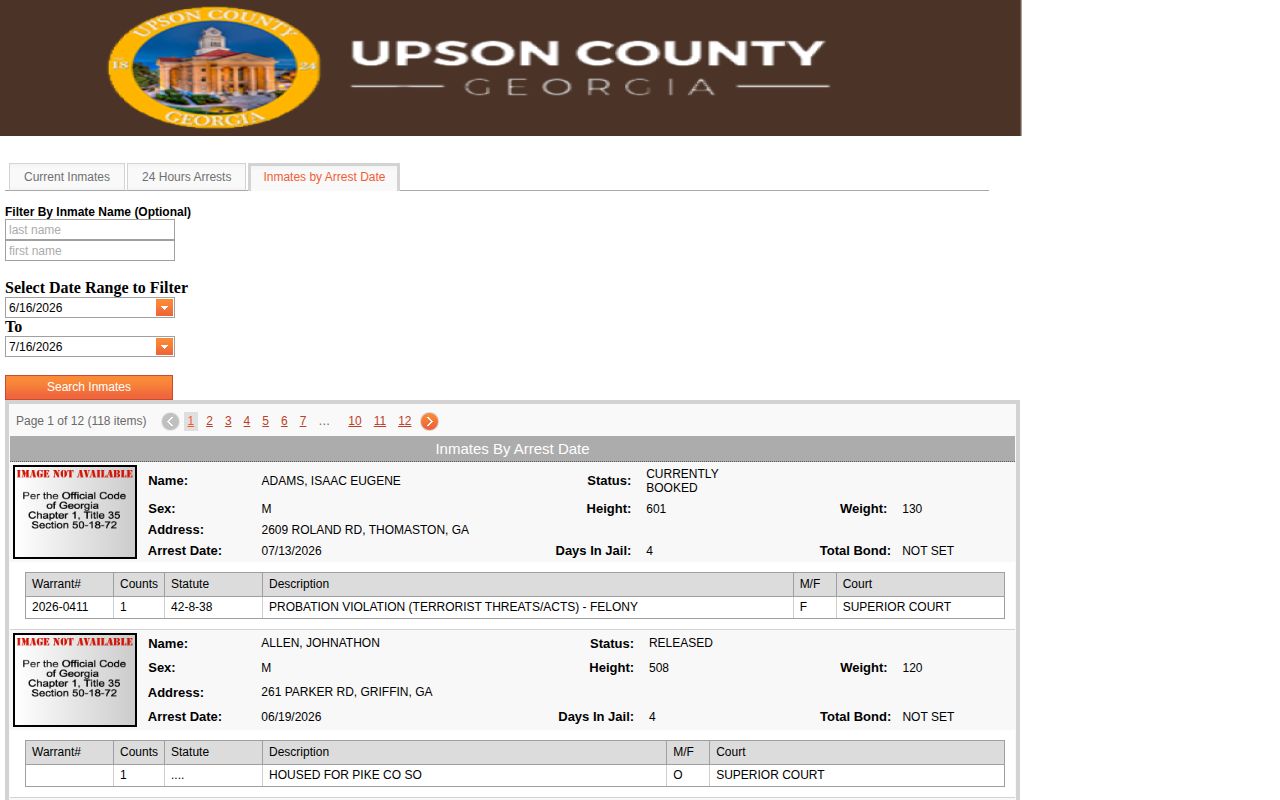
The captured page shows why date controls come first. The status inside each returned entry then answers whether that booking is shown as released.
Upson Three-Day Roster Fields
The date-range view uses booking facts much like the shorter roster view. It does not promise a booking number, exact release time, release reason, or named releasing officer. Read only what the source presents.
| Field | Use in a three-day check |
|---|---|
| Name and descriptors | Help select the correct person when names are alike. |
| Status | Shows released or currently booked for the displayed entry. |
| Arrest date | Places the booking in the selected calendar range. |
| Arresting agency | Identifies the sheriff, Thomaston Police, or another arresting office. |
| Days in jail | Provides the roster's duration value, not a certified release time. |
| Total bond | Shows an amount or a notation such as NOT SET or DENIED. |
| Charges and court | Connect the booking to alleged counts and the court path for disposition. |
The court field is valuable after release. It directs the next inquiry instead of assuming every case belongs in Superior Court. Upson entries can point to Superior, Probate, State, or City Court. Jail status and court outcome answer separate questions.
Upson Weekend Release Checks
A three-day search is useful after a weekend because one query can cover bookings across several calendar days. It also helps when a family member or support person could not check each day. No official source reviewed states a special weekend or holiday publication schedule, though. Do not assume an entry appears at a fixed hour.
Operational events can change custody at varied times. Bond can be posted, a court order can arrive, a sentence can receive time-served credit, or another agency can accept a transfer. The roster may update after processing. Search overlapping dates near a boundary, and call the jail when a prompt pickup, medication, safety, or transport decision depends on a current answer.
Verify an Upson Release Record
When the date-range view does not answer the question, contact Upson County Jail at 706-647-7411. Absence can mean the arrest date lies outside the range, the record changed, or a different agency owns the custody event. It does not establish release, transfer, or detention.
A targeted open-records request can seek the booking and release or discharge record. Include the full name, birth date if known, arrest date, and arresting agency. Ask for the commitment date, discharge date and time, release authority, issuing court, release type, bond details, and transfer or hold notes if available. Georgia's framework generally allows three business days for a response, records, or timetable. Lawful fees may cover copies, search, retrieval, and redaction.
Georgia VINE supplies custody-change notices where covered. Use GDC sources for state-prison custody and the named court for case disposition. Leaving jail does not close a pending charge by itself.
Why Upson Uses Date Search
The verified local sources offer current inmates, bookings from the last day, and bookings by a chosen arrest-date range. None is labeled as a rolling 72-hour release product. Date search is thus the accurate local substitute. It offers more control than a fixed three-day list but requires the user to interpret status inside booking records.
This structure explains why no publication cadence or retention promise should be invented. Those facts are not stated on the public page. If a formal response must establish every release in a period, request agency records instead of counting web results.
Upson Release Versus Transfer
Released from Upson custody does not always mean released to the community. Another jail, GDC, federal authorities, or immigration custody may receive the person. A detainer is an authority affecting release because another agency seeks custody. The local roster may show only that the county jail's role ended.
Confirm a destination through sheriff transfer notes and the receiving system. GDC's search applies after a state-prison transfer. BOP or U.S. Marshals records address federal custody, while ICE uses its own locator. The Upson court record remains the route for what happened in the local case.
Upson Release Window Gaps
A booking-date filter and a release-date filter are not interchangeable. Suppose a person entered jail a week ago and bonded out yesterday. A last-three-arrest-dates query may omit that person even though the release happened within 72 hours. Search the person's known arrest date when possible, then inspect status. If the date is unknown, ask the sheriff to search by identity and approximate booking period.
This gap is why the workflow focuses on a known person rather than producing a public roll call. A formal request can define the exact release period and seek responsive discharge records, subject to lawful limits and redaction.
Upson Three-Day Bond Context
Total Bond can help explain a possible short stay, but it is not a release-reason field. A number indicates an amount shown for the booking. NOT SET and DENIED convey different limits. Multiple charges, warrants, or holds may affect whether the person can leave even when one count has a numeric bond.
Read bond beside status. Released confirms that the entry no longer shows current Upson booking custody. It does not disclose who posted bond, which form was used, what conditions apply, or whether the person went to another custodian. The sheriff record and issuing court provide those details.
For court follow-up, use the court named in the entry. Upson bookings can lead to Superior, Probate, State, or City Court. A docket may outlast the jail entry and show later disposition or sentence action.
Request Upson Period Records
A person-specific request is usually clearer than asking for every release in a three-day span. Identify the person, known booking date, and agency, then name the fields needed. If a period list is required for a neutral records purpose, state exact beginning and ending dates and clarify that the request concerns discharge time rather than arrest time.
Ask for electronic production when available and request a cost estimate. A precise scope limits search time and helps the custodian locate the correct jail fields. Do not ask the clerk for jail discharge data when the sheriff maintains it. Use the court for case results and Thomaston Police for its incident or arrest report.
Match Upson Release Identities
Expand the arrest-date range only as far as needed. A broad query raises the chance of choosing the wrong person. Match physical descriptors, arresting agency, court, warrant, and charge. If facts conflict, stop and confirm them rather than combining two records.
A booking-date filter can also miss a person booked earlier and released during the selected period. Search the known original arrest date when possible. If it is unknown, give the sheriff the identity and approximate period so staff can locate the correct event.