
Upson Parole and Probation Compared
Parole and probation can both place a released Upson County person under rules in the community, but their legal sources differ. Parole is conditional release from a Georgia prison sentence. The State Board of Pardons and Paroles makes the release decision, and the Georgia Department of Community Supervision, or DCS, handles field supervision. Probation is imposed by a court. It may replace confinement, follow a jail or prison term as part of a split sentence, or continue after a short custody event. DCS supervises felony probation as well as parole.
The distinction controls where to verify the record. A person released from Upson County Jail on bond is not on parole merely because the person left custody. Someone booked for an alleged probation violation may already have a court supervision case. A state prisoner given parole enters a Board and DCS process. Read the sentence, release source, and agency together.
| Point | Parole | Probation |
|---|---|---|
| Who orders it | State Board of Pardons and Paroles | Sentencing court |
| Custody link | Follows release from state prison | May replace or follow confinement |
| Public verification | Parolee search, Board record, DCS | Court sentence and DCS |
| Upson field service | DCS Griffin field office | DCS Griffin field office for felony cases |
- Parole
- Conditional release from a prison sentence before the maximum term ends.
- Probation
- Court-ordered supervision in the community.
- Split sentence
- A sentence with confinement followed by probation.
- Discharge
- The formal end of a sentence or supervision term.
Verify Upson Post-Release Supervision
Start with the event that put the person in custody. The Upson County Interop roster may list an arresting agency, charge, court, bond, and status. It can also show probation-violation charges. Those details help route the check, but a jail entry is not a current supervision certificate. The Georgia parolee search accepts first name, last name, race, case number, UPI number, and GDC ID. Partial terms are allowed, so compare identifiers and do not rely on a name alone.
For felony probation, use the sentencing court and DCS. The court order establishes whether probation was imposed and states the term. DCS can confirm which office serves the case. A misdemeanor probation matter may follow a different local court path, so the court named in the Upson roster remains important.
- Determine whether the last event was county jail, state prison, or a court sentence.
- For parole, search the official parolee database by the best available identifiers.
- For probation, identify the sentencing court and obtain the sentence or later order.
- Contact DCS when felony parole or probation field supervision needs confirmation.
- Verify a conflict with the Board, DCS, or court that owns the record.
A released status means the person left that custody source. It does not show that probation, parole, a registration duty, or another agency's hold has ended. The full Upson County release path is described on the released-inmates home page.
Important: Absence from a jail roster or parole search is not proof that all supervision has ended.
Upson Probation Office Is Regional
Upson County does not appear on the reviewed DCS material as having a stand-alone Thomaston field office. The DCS Griffin field office serves Upson, Fayette, the Griffin Circuit, Pike, and Spalding. Its listed location is in Barnesville. This regional setup matters because a search for a local office by city name alone can miss the agency that actually serves an Upson County parole or felony probation case.
700 Legacy Park Dr
Barnesville, GA 30204
Primary phone: 770-358-5047
Monday through Friday, 8:00 a.m. to 4:30 p.m.
Upson/Fayette/Pike contact number listed by DCS: 770-296-9590
The office can route field-supervision questions, but it does not replace the court record or Parole Board decision. Provide a full name and a state or case identifier when known. If the issue is a county jail release rather than felony supervision, direct the record question to the Upson County Sheriff's Office instead.
The official DCS office page is shown in the captured source below.
View the DCS Griffin field office source.
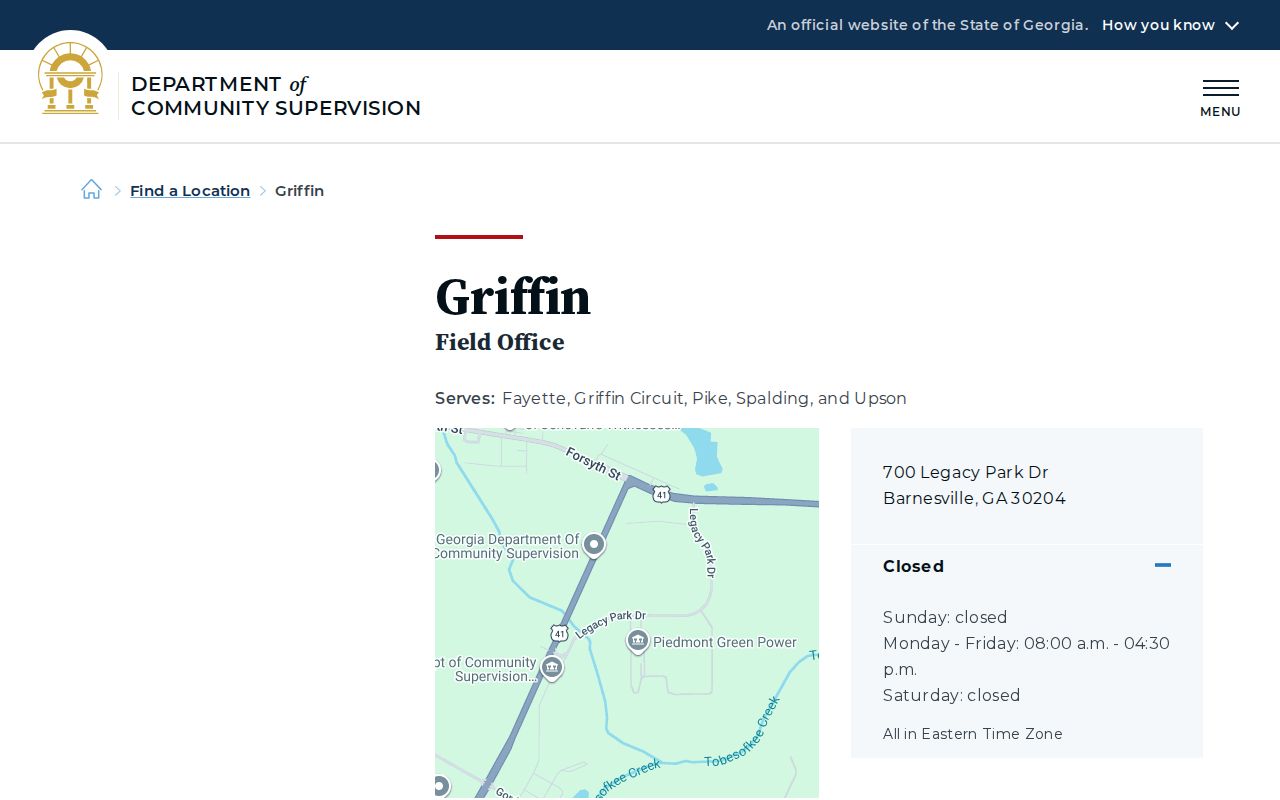
The office listing confirms that regional DCS service for Upson County is based in Barnesville.
Upson Parole Review Has No Calendar
Georgia's ordinary parole process is not a county court hearing calendar. Eligible state inmates are generally considered through Board file review. The public Georgia parole process explains that the Board may establish a Tentative Parole Month, called a TPM, or deny parole. A TPM is not a final release date. At final review, the Board may set an actual parole release date, reconsider an earlier decision, or take another lawful action.
The practical public timing tool is the TPM lookup, not the Board events page. Life-sentence cases are handled differently: the Board grants or denies parole rather than using the same TPM pattern for every case. A denied life case is reviewed again under Board policy, but the interval is set by the Board.
The captured parole-process source illustrates the statewide decision route used for an Upson County case that resulted in state imprisonment.
Open the official parole process source.
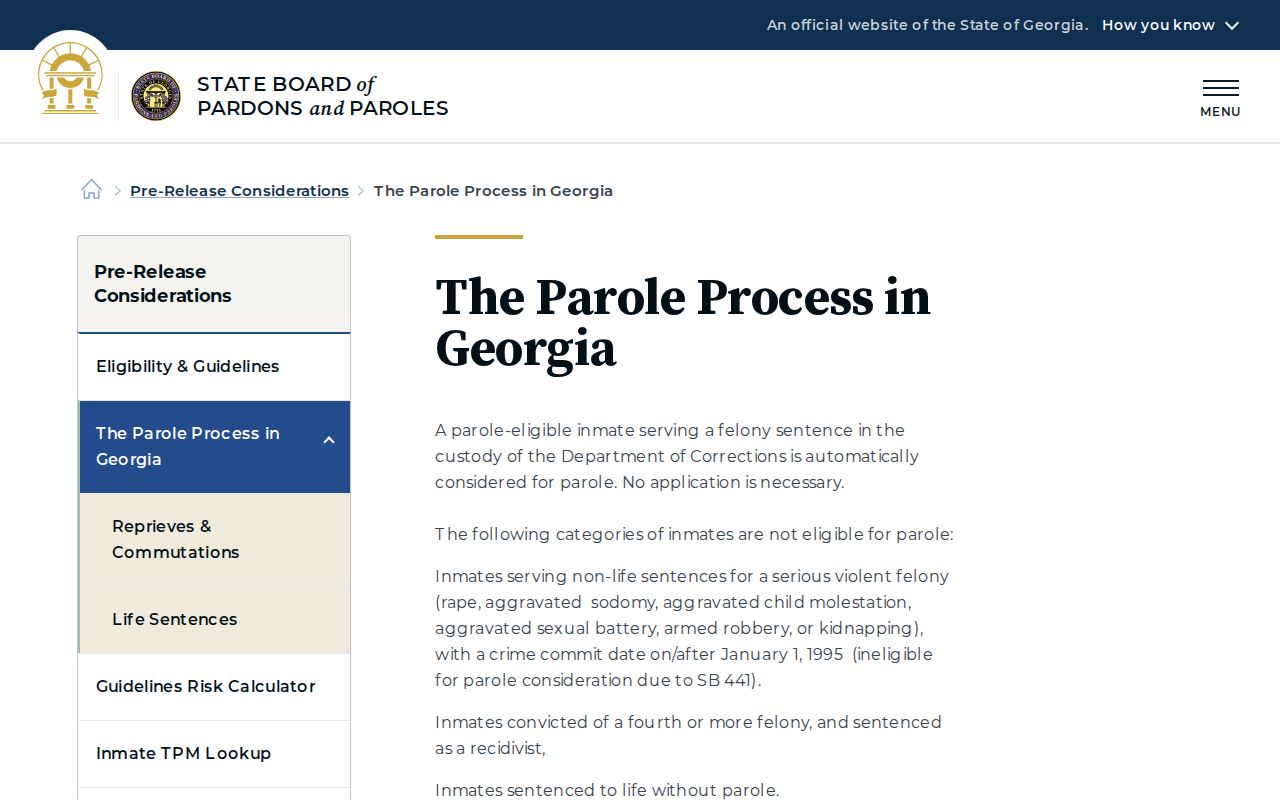
This statewide file-review process is separate from a bond or time-served release at Upson County Jail.
Upson Supervision Violations and Warrants
Supervision conditions are the rules set by the court, Parole Board, or supervising agency. They can include reporting, approved travel, program participation, and compliance with the law. The exact conditions belong to the person's order. A violation allegation is not the same as a final finding. It can lead to a warrant, jail booking, revocation process, or other response, depending on the record and the authority involved.
Upson's jail roster can show a probation-violation charge, including references to Georgia probation law. That entry proves only what the booking record reports. It does not prove a released person is now an absconder. An absconder is a supervised person alleged to have stopped reporting or whose location is unknown to the agency. Confirm that status through the parolee search, DCS, court record, and an official warrant channel.
Georgia VINE is designed for custody changes, not field-supervision status. An alert may show that someone left or entered a participating facility, yet it cannot establish whether a court later revoked probation or whether DCS closed the case. Agency ownership still controls.
Note: A new Upson jail booking can relate to supervision without showing the final result of the violation case.
Upson Release Property and Corrections
After release, ID, property, and record corrections follow the agency that created the item. Jail property and release paperwork go to the Upson County Sheriff's Office. A Thomaston Police Department incident record follows the city's open-records path when city police made the arrest. A court clerk corrects or supplies the court docket. GDC handles its state-prison record through Inmate Records and Information.
Upson's online roster does not publish the property-return sheet or exact discharge papers. A focused written request should name the person, booking date or number, and the exact record sought. Georgia's Open Records Act generally requires production within three business days or a response describing when responsive records can be produced. GDC directs written verification to Inmate Records and Information, PO Box 1529, Forsyth, GA 31029.
Keeping each request narrow helps distinguish a jail release form from a court order or supervision record. Those records can describe the same person while answering different questions.
How Upson Supervision Ends
Supervision ends through formal authority, not because a name disappears from a search result. Probation normally ends when the court-imposed term is completed or the court enters a lawful early termination or discharge order. Parole ends when the sentence and parole authority reach discharge. A release from physical custody begins supervision in many cases; it does not end it.
Ask for the record that matches the claim. For probation, seek the sentence and any later discharge or termination order from the court. For parole, use the parolee search and Board record, then verify with DCS when needed. For a completed state sentence, GDC records may show sentence or discharge data. Georgia first-offender provisions can limit public access after discharge in qualifying cases, but release alone does not restrict the arrest or court record.
A person can also be off parole yet remain subject to another lawful duty. Registry requirements, a separate probation case, or a new court order are distinct. Confirm each through its originating office rather than treating one discharge as a universal end date.
Keep the identifiers used in the verification. A GDC number, court case number, UPI number, or written discharge date makes a later correction much easier than a name-only search. It also helps the Griffin field office distinguish two people with similar names.
Georgia first-offender discharge can create another record issue. A qualifying discharge may limit public access under state law, yet it is not the same event as release from jail or prison. The court clerk and prosecutor record are the sources for that legal status. DCS can address supervision, while the sheriff can address the earlier Upson custody event.