
Upson Projected and Actual Release
A projected date is an estimate or sentence-administration date calculated before release. An actual release date records what happened. They can differ. In Upson County Jail, bond may be posted, a judge may change an order, a hold may clear, or another agency may take custody. The public Interop roster shows status, arrest date, days in jail, bond, charges, and court, but it does not publish a future release-date field.
State prison has other terms. A Maximum Release Date, or MRD, reflects the prison term if no earlier parole or other authorized reduction occurs. A Tentative Parole Month, or TPM, is when the Parole Board expects final review. It is not a promise of release. Sentence End Date is an administration term that can reflect sentence length, credit, and periods when the sentence did not run.
Scheduled versus actual: A projected date guides a check. Only the agency's final custody record confirms the actual release.
A pretrial detainee has no computed sentence end. The next event may depend on bond, a hearing, dismissal, trial, plea, or a detainer. Applying a state-prison TPM to an Upson jail bond case gives the wrong answer.
Find an Upson Inmate Release Date
Begin with the last known custodian. Use Upson Interop for local jail status. Use the Georgia Department of Corrections for state prison. Federal prison dates belong to BOP, while ICE's locator addresses current immigration detention rather than a county release archive. A transfer out of Upson custody is not necessarily community release.
- Check the Upson current-inmate roster if present custody is the question.
- Read the recent and arrest-date views for a local record marked
RELEASED. - For a county sentence, ask the jail and named court for the sentence, jail credit, holds, and release authority.
- For state prison, open GDC Find an Offender or its direct query and match the GDC ID and other identifiers.
- Use the official TPM lookup if parole timing applies.
- Request written verification from the agency when an exact date matters.
GDC says its public search is a locator and directs users to verify by writing Inmate Records and Information, PO Box 1529, Forsyth, GA 31029. The broader county-jail search and records workflow appears on the Upson released-inmates home page.
Note: A missing jail name can reflect release, transfer, data lag, a mismatch, or another custody system.
Georgia Credits Shape Upson Release Dates
Georgia projected timing is not one simple percentage. The GDC Performance Incentive Credit program, called PIC, allows eligible state offenders to earn points through approved programs and work. The official GDC PIC page says an eligible person may earn up to twelve points and may receive one to twelve months off a TPM or MRD. Credit affects a state sentence calculation, not a county jail bond decision.
PIC does not apply to every offender. Eligibility can depend on the sentence and offense, and the Parole Board can reconsider parole timing. Georgia's work-incentive-credit statute is O.C.G.A. § 42-5-101. Serious violent felony restrictions appear in O.C.G.A. § 17-10-6.1. Those rules can limit parole and sentence reductions for listed crimes.
The common claim that every Georgia prisoner serves eighty-five percent is too broad. Parole eligibility, mandatory service, sentence type, PIC eligibility, court credit, and Board action all matter. Federal prisoners follow federal credit law, not Georgia PIC.
Review the official GDC PIC source shown below.
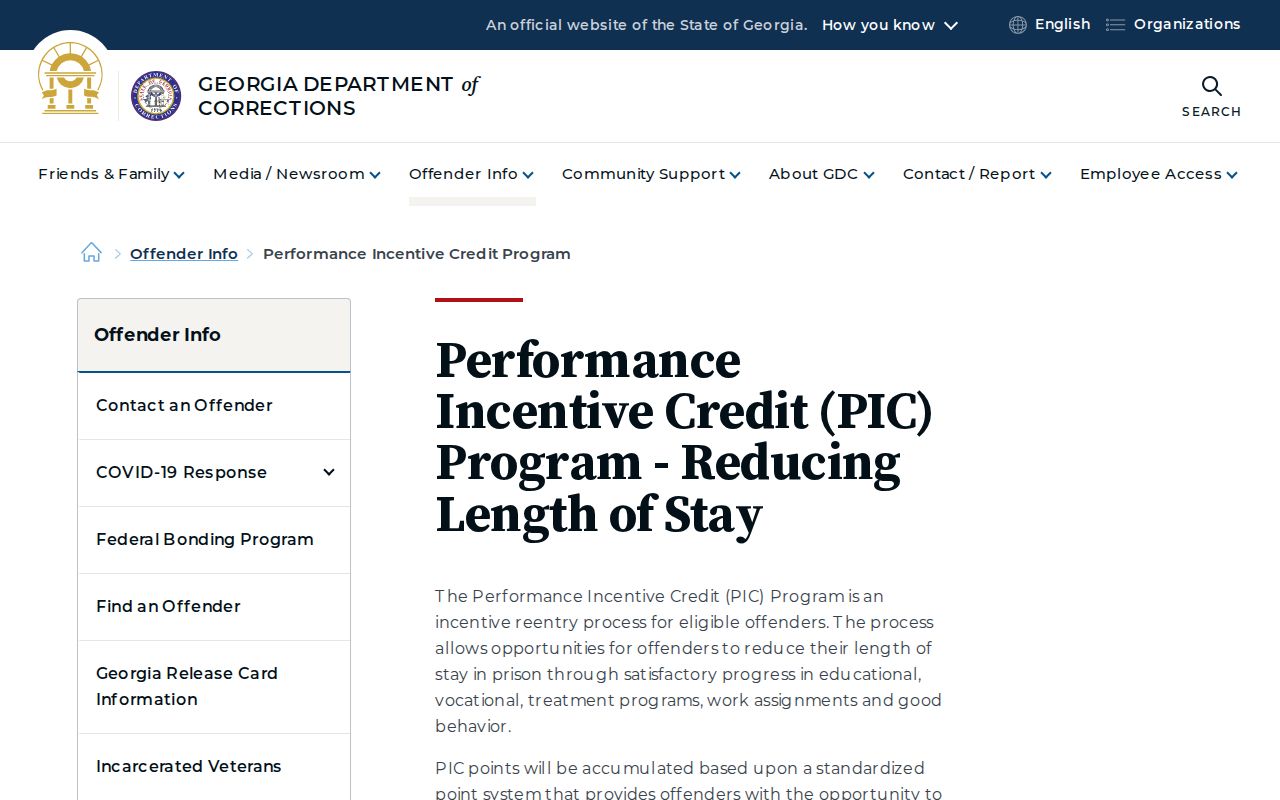
The source explains why a state projected date can move after eligible program credit is applied.
Upson Parole Timing Uses TPM
For a parole-eligible person sentenced from Upson County to state prison, the State Board of Pardons and Paroles owns parole timing. General eligibility under O.C.G.A. § 42-9-45 does not equal release. The Board may set a future TPM or deny parole, and it may reconsider before the person leaves prison. A TPM is the month of final review, not the final day at the gate.
The Board TPM lookup is the practical public tool. Search with accurate identifiers. For non-life cases, a TPM may appear. Life cases use different grant or denial decisions and parole consideration dates. The Board's normal process is file review, not a public Upson County hearing calendar.
See the Parole Board TPM lookup source captured below.
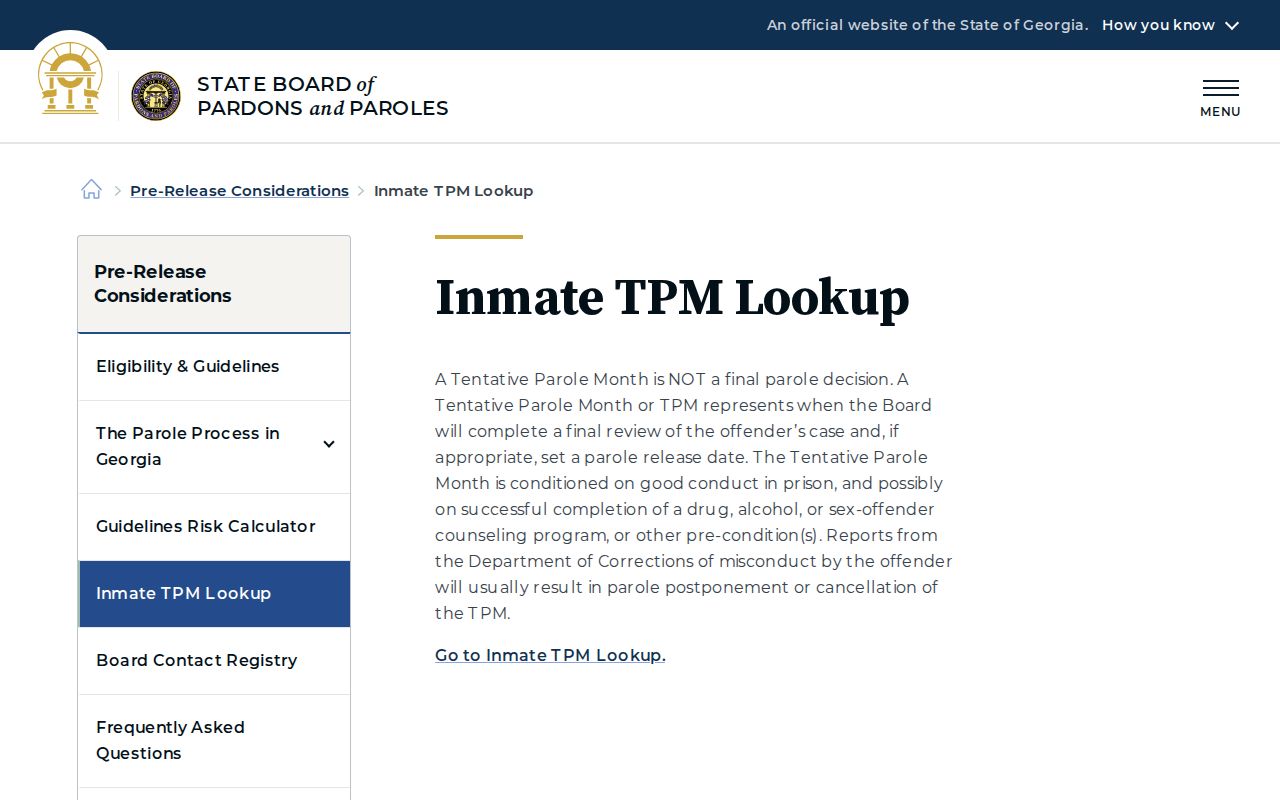
The TPM tool supplies parole timing for state prisoners, not projected bond-out dates at Upson County Jail.
Why Upson Release Dates Change
The agency that owns the custody record also owns most date changes. Local jail timing can move fast because the event is tied to a judge, bond, sentence credit, or outside hold. State timing follows sentence computation, Board action, earned credit, discipline, and other legal changes. No single public field captures every pending event.
| Factor | Possible effect | Verify with |
|---|---|---|
| Bond or court order | May permit or delay county release | Upson jail and named court |
| Jail or sentence credit | Can change completion timing | Court and custody agency |
| Detainer or hold | May cause a handoff instead of community release | Jail and holding agency |
| TPM or parole decision | May move or deny earlier state release | Parole Board |
| PIC or discipline | May reduce or change eligible state timing | GDC and Board |
| Sentence recalculation | Can revise MRD or end date | GDC records |
A release from Upson County custody to ICE, USMS, another county, or GDC still ends the local jail event. It does not mean the person is free from custody. Ask whether the entry was community release or transfer.
Upson Jail Publishes No Projection
Upson County's local roster has useful facts, but a projected release date is not one of the verified public fields. The display includes name, status, arrest date, arresting agency, days in jail, total bond, charges, warrant data, and court. Numeric bond, NOT SET, or DENIED can explain the posture of a case, yet none establishes the future release time.
For a county sentence, request the court order, credited time, and jail calculation. For a pretrial case, ask about bond and holds. For a transferred state-sentenced person, switch to GDC. This local distinction is the core Upson release-date quirk: the county roster confirms present or recent status, while Georgia prison timing relies on MRD, TPM, PIC, and parole rules.
Written requests under Georgia's Open Records Act can seek the date and time of actual release, release type, transfer destination, and release authority after the event. The Act generally calls for production within three business days or a response giving a timeline when responsive records cannot be produced then.
The Upson roster's arresting-agency and court fields can also prevent a misrouted request. A Thomaston Police arrest may still result in an Upson County Jail booking. The police department can own the incident file, the sheriff can own the booking and discharge record, and the listed court can own the bond or sentence order. Each agency answers a different part of the date question.
Days In Jail is retrospective. It can help a reader understand the stay shown in the vendor record, but it is not a countdown. Total Bond is also limited. A numeric amount may support a possible bond path, while NOT SET or DENIED describes the displayed posture. None proves that money was posted, every condition was met, or every hold cleared.
Upson Release Dates by Custody
A county release date can mean bond-out, time served, dismissal with no other hold, sentence completion, or transfer. The discharge record should state the release type or authority. When the person is transferred to GDC, ICE, another county, or federal custody, the Upson event ends but another custody record begins.
A state-prison release can be parole, maximum release, or another authorized discharge. Parole creates community supervision through DCS. Maximum release and sentence end are related terms but should be read from the official state record rather than inferred from the original sentence alone. Tolling, jail credit, concurrent or consecutive terms, and recalculation can affect administration.
Federal timing belongs to BOP. Its locator can show a release date, and BOP explains that a past date with no facility location generally means the person is no longer in BOP custody. Another justice system may still supervise or hold the person. ICE's locator has a different job: it helps locate a person currently detained by immigration authorities.
The safest question is therefore precise: released from which agency, on what authority, and into what status? That wording separates a county transfer from community release and a prison release from the later end of supervision.
Confirm Upson Actual Release Dates
Use Georgia VINE for a custody-change alert where the person and facility participate. Registering before release is most useful. An alert is still a signal from a participating feed, not the full sentence record. Confirm Upson jail events with the sheriff, state prison events with GDC, and parole releases with the Board and DCS.
If two official sources disagree, record the identifiers, status, facility, and date shown by each. Then contact the agency that maintains the sentence. A court clerk can provide the order, while the custodian can provide the discharge or transfer record. GDC's written-verification route is especially important when the public locator does not show a clear historical result.
County, state, and federal release dates cannot be blended. BOP maintains federal release information. ICE ODLS helps locate current immigration detention. USMS custody changes may involve local housing but remain federal. Correct routing prevents a local roster change from being mistaken for the end of all custody.
A formal county request should ask for the actual date and time, release reason, releasing authority, and transfer destination if one exists. Include the full name, date of birth if known, booking date, and booking number. The arrest date is not a substitute for the release time, and days in jail is not a discharge record.
For a state record, keep the GDC ID, sentence fields, facility history, MRD, TPM, and actual release or discharge status together. One field can answer a narrow question while leaving another open. For example, a TPM can describe review timing without showing that the Board ultimately released the person in that month.
Parole release also creates a second date question. The person may leave prison on one day but remain under DCS supervision until a later discharge. The parolee search and Griffin field office can clarify that post-release phase for an Upson County case.